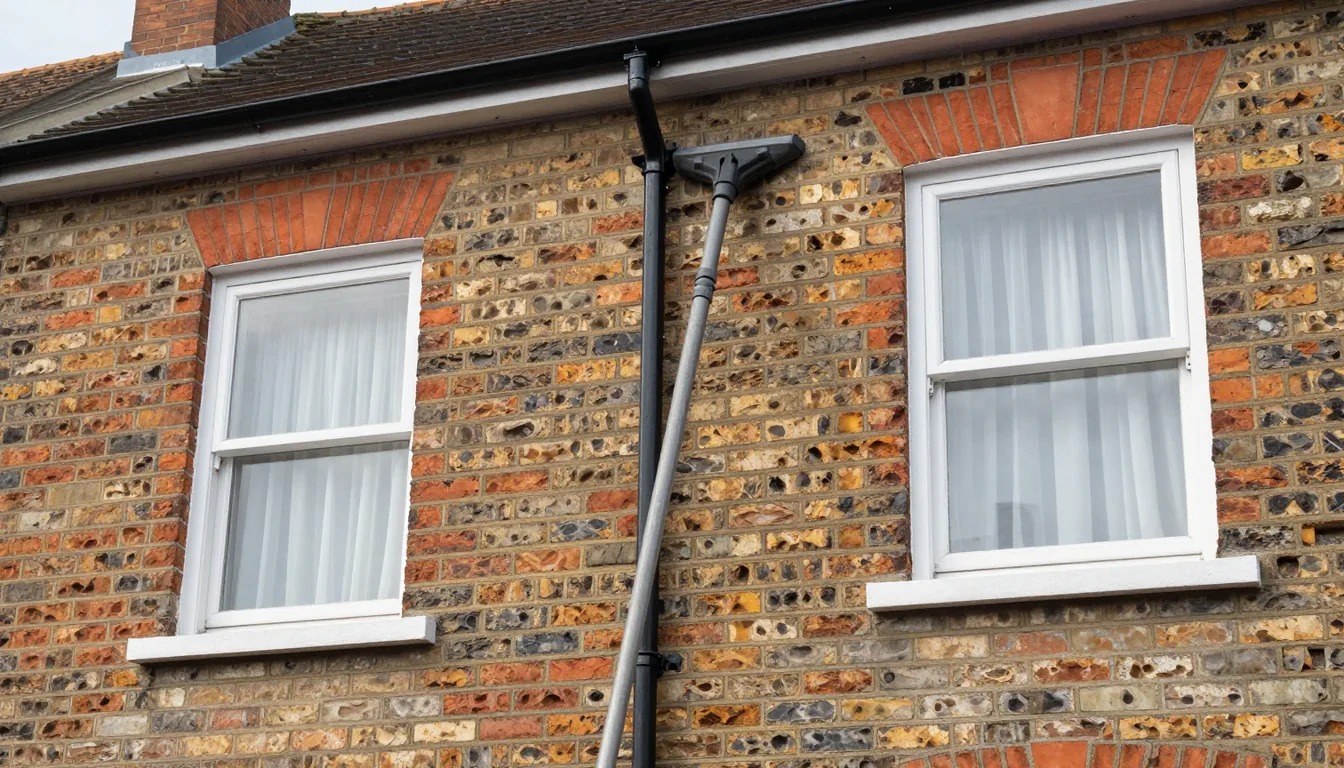
How a telescopic gutter cleaner and vacuum lets us clear gutters from the ground, why it's safer than ladders, and what to expect on the day.
Falls from ladders remain one of the most common causes of serious injury in and around UK homes, and gutter clearing is a classic culprit. Leaning a ladder against fragile plastic guttering, reaching sideways with a trowel in one hand, is exactly the situation safety guidance warns against. That is why most of our work is done from the ground, using a telescopic gutter cleaner connected to a powerful vacuum. This guide explains how the method works, where it shines and what you can expect when we visit your Kent home.
Why avoid ladders in the first place?
A ladder is a perfectly good tool for some jobs, but gutter clearing is a poor fit. You are working at height, usually on uneven ground or a sloping drive, and the load is applied sideways to the top of the ladder, which is resting against the very thing you are trying to clean. Plastic guttering can crack or pull away from its brackets under that pressure, and a ladder foot can slip on wet leaves or moss.
Working from the ground removes most of those risks. There is no climbing, no reaching, and no weight pressing on your fascia boards. It also means we can clean first-floor and two-storey runs without scaffolding or access towers in most cases.
What is the pole-and-vac method?
The system has three parts:
- A telescopic pole made from lightweight carbon or aluminium sections that extend to the height of a typical two-storey house.
- A cleaning head, often with a small camera, so the operator can see inside the gutter on a monitor while working.
- A vacuum unit on the ground that draws debris down the hose and into a sealed collection tank.
If you would like the full explanation of the equipment itself, our guide to what a gutter vac is and how it works covers it in plain English.
How a typical clean works
Every property is different, but the sequence is usually the same:
- Walk-round and assessment. We look at the roofline, the type of guttering and any obvious problems such as sagging runs, loose brackets or overhanging trees.
- Set-up. The vacuum goes on the drive or pavement, and the pole is assembled to suit the height of the building.
- Clearing the run. The head is guided along the gutter, loosening compacted leaves, moss and silt, which are then pulled straight into the tank. The camera lets us check that nothing is left behind.
- Downpipes. Blockages often sit at the outlet or lower down, so we check that water can flow freely. Our downpipe clearance service deals with stubborn blockages.
- Final check. We look along each run again and, where possible, take before-and-after photos so you can see what was removed.
Because the debris goes into a tank rather than being thrown down, there is far less mess on your paths, patios and windows.
Where the method works best
The pole-and-vac approach suits most standard homes in Kent, including terraces, semis and detached houses up to about three storeys of gutter line. It copes well with leaves, moss, seeds and the muddy silt that builds up in older gutters, and it is gentle on uPVC, cast aluminium and most other common materials.
It is particularly useful where:
- access to the roof or fascia is awkward, for example above a conservatory or extension;
- the guttering is old or brittle and could be damaged by a ladder;
- there are overhanging trees, such as the oaks and sycamores common across Kent, that drop heavy debris;
- you would simply rather not have anyone on a ladder at your property.
Where it has limits
No method is perfect, and it is worth being straight about that. Very heavily compacted blockages, set-solid moss or objects such as tennis balls may need extra loosening before the vacuum can shift them. Some roof shapes or very tall buildings may need a different approach, and tiles, fascias or guttering that are visibly damaged are better assessed in person. If we think a ladder or other equipment is genuinely needed, we will say so rather than force the method to fit. If cleaning shows a deeper problem, such as split joints or sagging runs, you can read more about your options in our guide to gutter repair versus replacement.
What to expect on the day
You do not need to do much. Please make sure we can reach the front and back of the property, and move any vehicles or garden furniture that are in the way. There is no need to be at home throughout, though it helps if someone can let us know about any known problem areas. Most houses take a relatively short visit, depending on size and condition. Opening hours are Monday to Friday, 8am to 6pm.
How often should gutters be cleaned?
Most homes benefit from at least one clean a year, ideally in late autumn once the leaves have fallen. Properties near trees may need a second visit in spring. Regular maintenance is far cheaper than repairing water damage, as explained in our article on whether blocked gutters can cause damp or subsidence.
Ready for a safe, ground-based clean?
Our full gutter cleaning service covers gutters and downpipes across Kent, using the pole-and-vac method wherever it suits your property. If you are curious about the kit we bring, take a look at the tools professional gutter cleaners use. When you are ready, request a free, no-obligation quote through our contact form and tell us a little about your home.